
Polycentric spatial structure in German state and regional spatial plans: An LLM-assisted census of what is articulated, why, and how
Polycentricity is among the most frequently invoked goals in European spatial planning, and nowhere more so than in Germany, where a balanced system of central places has been a constitutional commitment to equivalent living conditions for decades. Yet the term travels easily. A plan can name polycentricity as a settlement principle, as a justification for infrastructure investment, or as a rule governing where retail may locate — and these are very different commitments.
This project treats the plans themselves as the data. Using a large language model in an assisted-coding workflow, we read the corpus of German state spatial plans (Landesentwicklungspläne) and regional plans (Regionalpläne) and extract every clause that invokes a polycentric spatial structure, classifying each along three dimensions:
- What is articulated — the substantive claim about spatial structure itself;
- Why it is pursued — the justification offered, whether equity, efficiency, environmental, or economic;
- How it is to be achieved — the instrument, from binding designations to advisory guidance.
Every extracted clause is traced back to its source passage, so the classification can be audited rather than taken on trust.
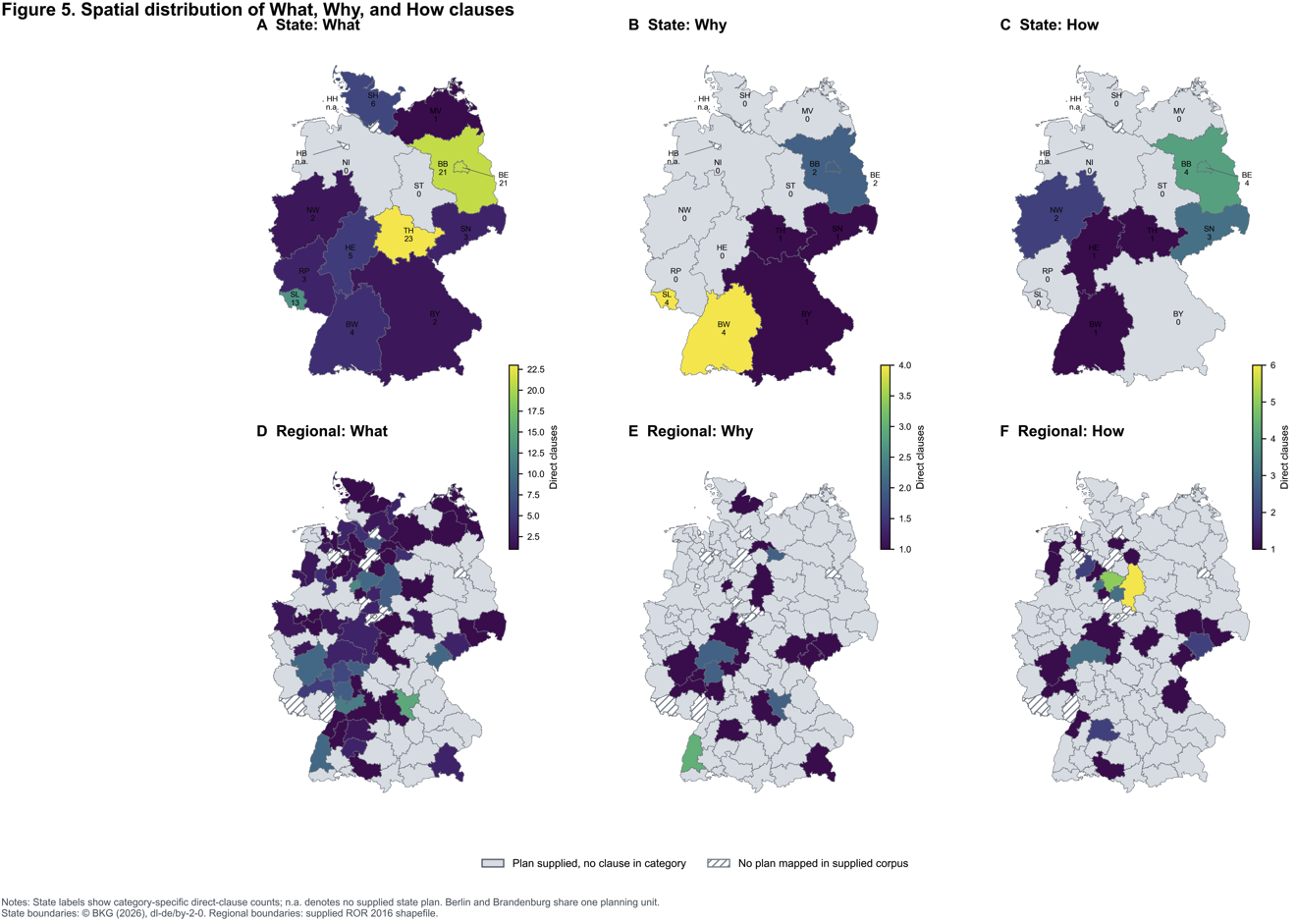
The first results show how uneven the articulation is. Thuringia, Brandenburg/Berlin, and Saarland carry dense What language, while much of the north and west says comparatively little in explicit terms. Why and How clauses are far scarcer everywhere — plans are much more willing to assert a polycentric structure than to justify it or to specify the instrument that would deliver it.
Interactive: the vocabulary of polycentricity
Alongside the clause census, we map the vocabulary itself: which terms co-occur with polycentricity across the corpus, and how those terms cluster into distinct planning discourses. Explore the co-occurrence network below.