
Urban morphology and the heat island effect in African cities: Evidence from Ghana, Togo, and Tanzania
Published in Remote Sensing Applications: Society and Environment, 2026 · Download PDF
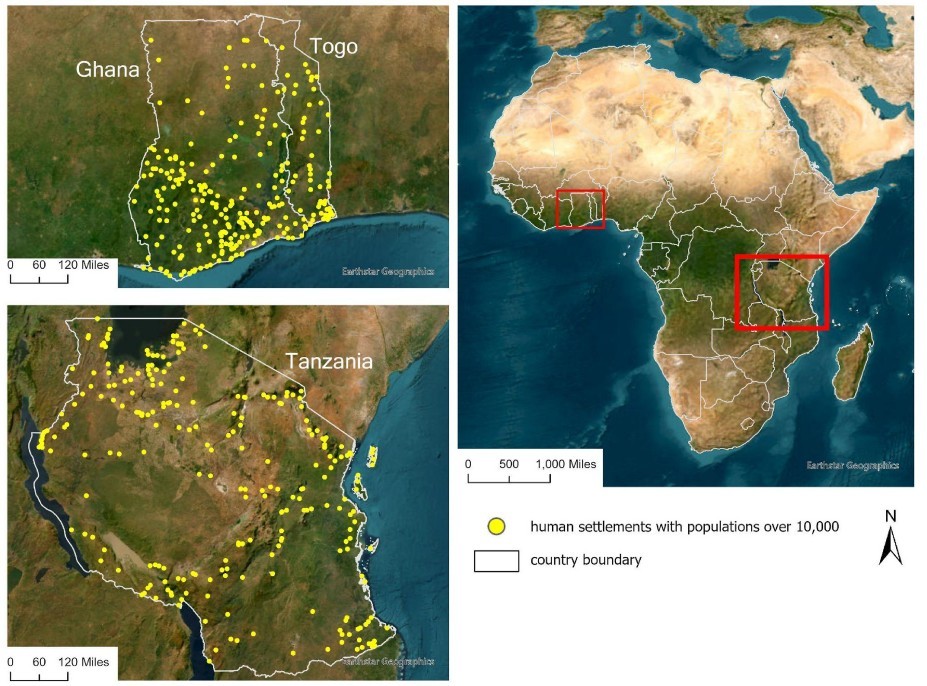
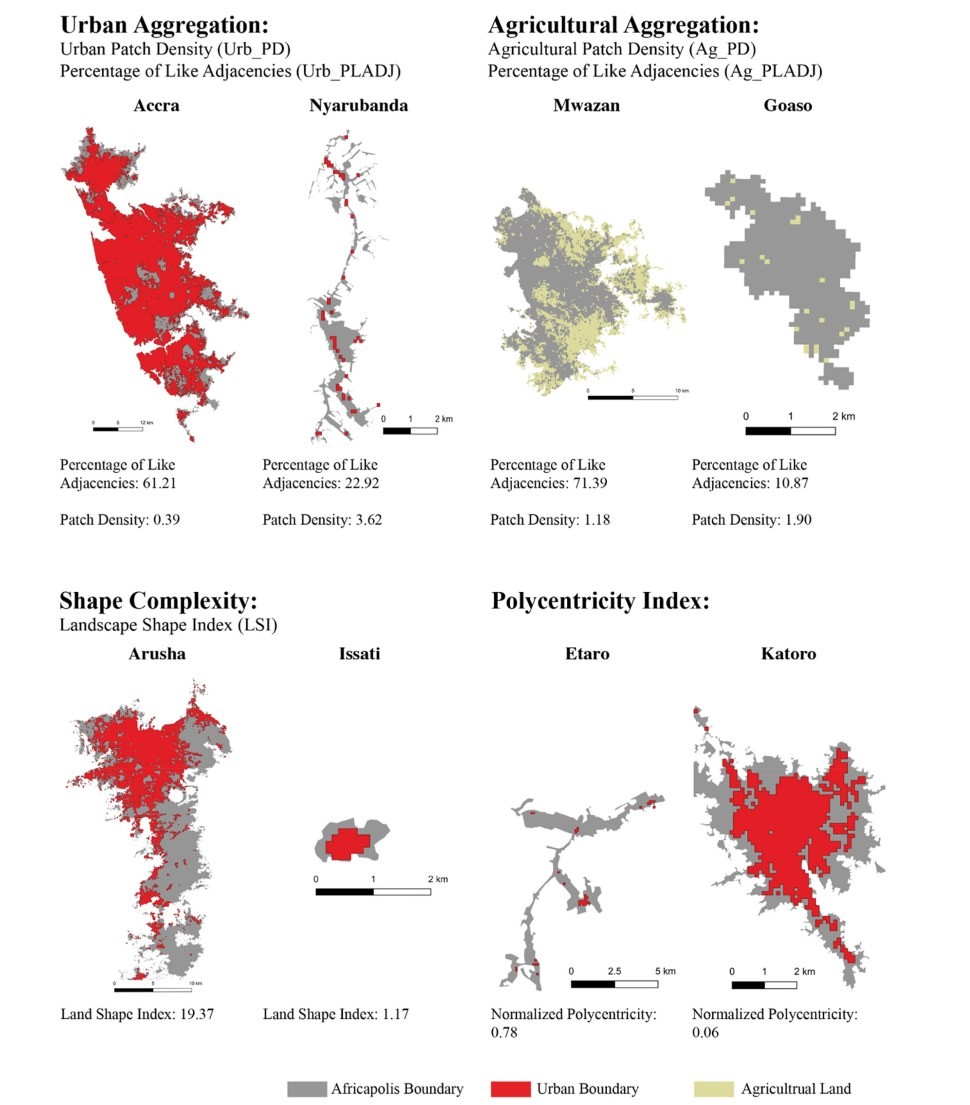
Urban heat islands (UHI) are an increasingly urgent concern in rapidly urbanizing regions, yet empirical evidence from Sub-Saharan Africa remains limited. This pilot study examines how urban morphology influences UHI intensity across 388 urban settlements in Ghana, Togo, and Tanzania, adapting conventional approaches to data-poor environments. We integrate MODIS land surface temperature with high-resolution land cover and Africapolis settlement boundaries, introducing an adaptive rural baseline that accounts for elevation and cropland exclusions to isolate urban–rural thermal contrasts. Using class-based and landscape-level metrics, we evaluate the role of land use composition, fragmentation, and settlement form in shaping daytime UHI through ordinary least squares regressions.
Similar to studies elsewhere, we show that contiguous urban development intensifies UHI, while fragmented urban fabrics help mitigate heat. However, distinctive patterns also emerge. Peri-urban agricultural cohesion significantly reduces UHI, and irregular settlement shapes, often reflecting ribbon-like development along roads, are associated with stronger UHI effects. These findings diverge from results elsewhere, underscoring the importance of context-specific analysis. Methodologically, the study demonstrates that UHI metrics can be adapted to African cities. The results highlight how preserving peri-urban agriculture and maintaining heterogeneous settlement structures can help reduce heat stress in resource-constrained urban environments.
Keywords: urban heat island; urban morphology; Sub-Saharan Africa
Recommended citation: Schmidt, S., Zhang, Y., Li, W., & Li, H. (2026). Urban morphology and the heat island effect in African cities: Evidence from Ghana, Togo, and Tanzania. Remote Sensing Applications: Society and Environment, 42, 102005.