
Who speaks for the neighborhood? Localism and opposition to housing in public hearings and online comments
Opposition to new housing is usually treated as a neighbourhood phenomenon: the people who object are assumed to be the people who live next door, and the standing of an objection often rests on that proximity. This project tests the assumption against the full public record of 285 rezoning projects in the City of Vancouver that generated both a public hearing and written comments.
Every speaker and comment is placed on two axes at once — the channel they used, and how close to the site they are — producing four groups that can be read against each other.
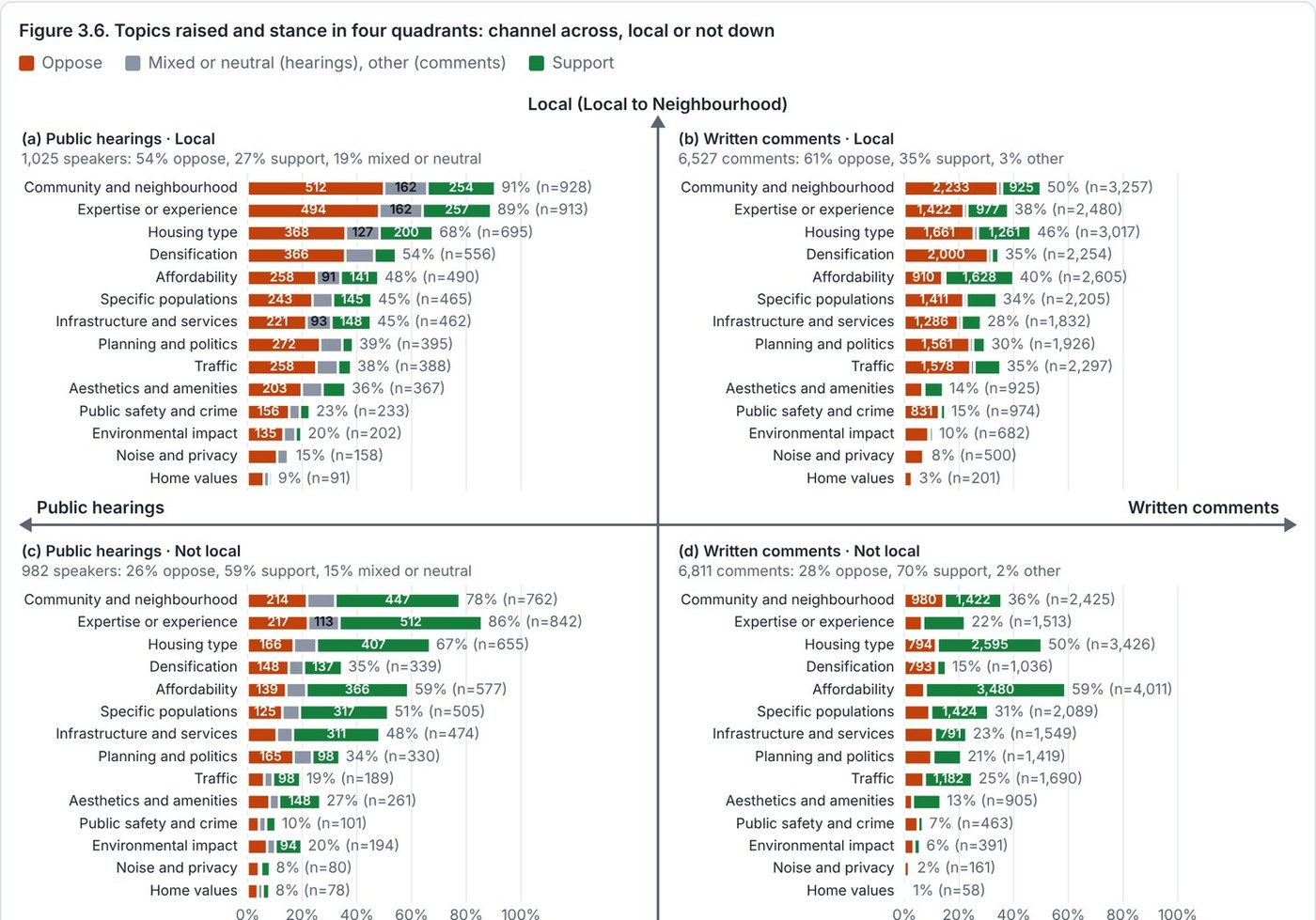
The gap runs along proximity rather than channel. Among the 1,025 people who spoke at a hearing from the surrounding neighbourhood, 54% opposed; among the 982 who spoke from elsewhere in the city or outside Vancouver, only 26% did, with 59% in support. The written record splits the same way and more sharply: 61% opposed among 6,527 local comments against 28% among 6,811 non-local ones.
What the two groups talk about differs as well. Local participants concentrate on densification, traffic, and the character of the surrounding community; non-local participants raise affordability and housing type far more often, and in support. The hearing and the comment form select for somewhat different voices, but the substantive divide is between those speaking for the block and those speaking for the city.