
Vertical price curves in the Beijing residential housing market
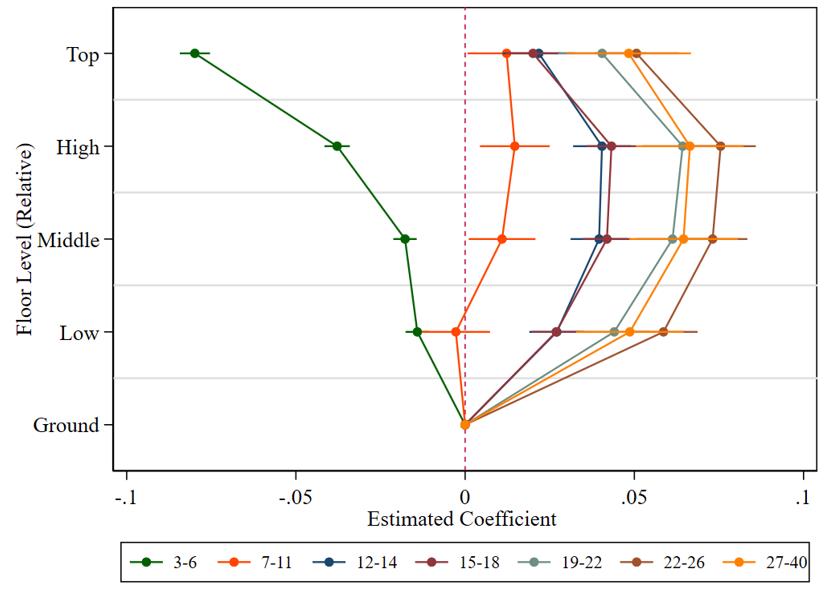
This paper investigates the presence and extent of the top-floor discount (TFD) and ground-floor premium (GFP) within the Beijing resale housing market, while also examining their interaction with building height. Using a comprehensive resale housing units dataset covering around 600,000 records from 2012 to 2019, we find that the ground-floor premium averages around 5% and the top-floor discount ranges from 6.4% to 8.5%, regardless of building height. As we take building height into consideration, the housing price gradient of low-rise buildings (with 6 stories or less) display a downward-sloping shape, indicating the existence of both top-floor discount and ground-floor premium. For high-rise buildings (7 stories or higher), the ground-floor premium gradually disappears as building height increases, while middle- and high-floor units become the most favorable choices for homebuyers. The top-floor discount persists even in high-rise buildings. In the mechanism analysis, we find that the presence of an elevator can transform the top floor discount into a premium in low-rise buildings, suggesting whether equipped with an elevator or not directly determines the presence of a premium or a discount for top floors. Moreover, rain leakage concern associated with poor building quality is an important factor determining the prices of top floors in high-rise buildings.